Robert Greenway: “I think there is a disconnect in Europe between national security requirements and economic policy.”
Kalenderwoche 12 // US-Perspektive
Die neue geopolitische Weltordnung beginnt aus Sicht der US-Regierung mit einer entscheidenden Voraussetzung: der dauerhaften Schwächung Irans. Robert Greenway, Direktor des Allison Center for National Security der Heritage Foundation, erklärt im Gespräch mit Lagebild Sicherheit die strategischen Ziele der USA im Nahen Osten. Er erläutert, warum die US-Regierung darauf abzielt, Irans militärische Fähigkeiten dauerhaft zu zerstören und damit die strategische Ordnung in der Region zu verändern. Ein geschwächter Iran könne Terrornetzwerke, Raketenprogramme und nukleare Ambitionen nicht mehr aufrechterhalten. Zugleich sieht Greenway darin einen Hebel im globalen Wettbewerb mit Russland und China – über Einfluss auf Energiepreise und Handelsrouten. Europa fordert er auf, Wirtschafts- und Sicherheitspolitik enger zu verbinden und seine industrielle Basis zu stärken. Greenway ist einer der einflussreichsten Berater des US-Präsidenten in Sicherheitsfragen und gilt als Architekt der Abraham-Accords, welche die Beziehungen zwischen Israel und mehreren arabischen Staaten normalisierten.
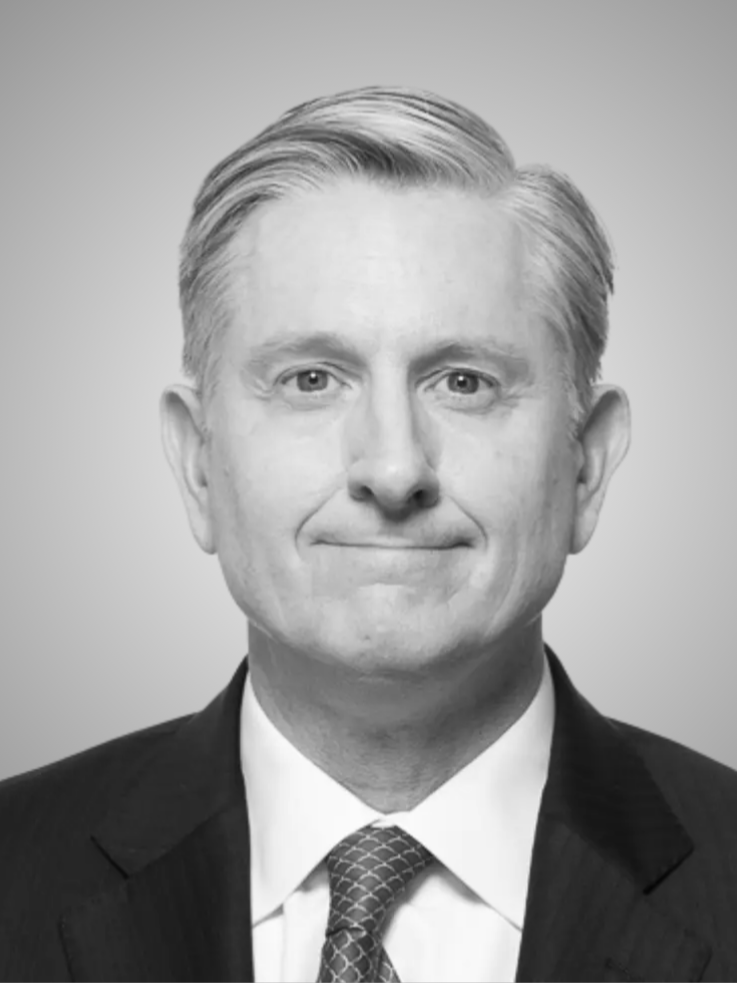
Robert Greenway, Direktor des Allison Center for National Security der Heritage Foundation
Dear Mr. Greenway, thank you for taking the time to talk to us today. I would like to start with what many in Germany are wondering: What will happen in Iran over the next three months?
I think the United States is approaching its stated objectives, which are essentially to deplete Iran’s capacity to threaten the United States, our partners and allies, global trade and global energy markets. That happens in three principal ways.
The first is the nuclear program, which has already been significantly degraded after the twelve-day war and Midnight Hammer. It is now continuously being bombarded, its infrastructure is being depleted, and personnel inside Iran are being targeted. That pushes Iran’s breakout time even further back and reduces its capacity to resurrect the program. The second is the ballistic missile program, which threatens the region directly and serves as the guise under which Iran is developing an intercontinental ballistic missile capability. Iran can already reach Europe and Israel, and it is working toward the ability to reach the United States. That entire program has to be destroyed.
The third is the network of surrogates and terrorist proxies that Iran sponsors throughout the region. Those are also being radically depleted by Israel and the United States together.
I would add a fourth dimension, which is the Iranian navy, as it continues to provoke, threaten, and constrain the movement of oil and cargo through the Strait of Hormuz. The United States has already destroyed more than sixty ships. So, in practical terms, most of Iran’s capacity has already been destroyed. And it is important to note that this is not, in the classic sense, a war. Iran does not have the capacity to wage war against Israel, and it does not have the capacity to wage war against the United States. It is, in effect, defenceless.
Looking at this from a wider perspective: How will the region change if Iran lost its ability to threaten the United States and its allies?
If we imagine a regional order in which Iran no longer has the capacity to sponsor terrorism, threaten shipping, pursue a nuclear breakout, or maintain its missile program. Then the Middle East looks fundamentally different. Let me explain this further.
First, there would no longer be a direct threat to U.S. interests in the region. That matters because the United States has maintained a permanent and very substantial force presence in the Middle East for decades. Since 1950, on average, the United States has had roughly 29.000 troops in the region every single day. We would not have to do that if Iran no longer threatened our interests to the extent that it does now.
Second, our partners and allies in the region would be more than capable of dealing with whatever threat remains without the United States. That does not mean abandoning the region. However, it means we would have to commit less to it. That would allow us to focus on other threats.
So, the idea of this operation is to free U.S. resources in the future?
There is also a broader strategic effect. Greater control over stability and energy flows in the region means much greater influence over global energy markets. That has immediate implications for Russia, because lower energy prices reduce the resources available to Putin. It also has implications for China, because China is dependent on exports from the region and on access to oil. If we can affect that access, then we affect the energy base on which China’s military power depends. So, the consequence is not simply a weaker Iran. It is a different strategic worldwide environment in which the United States has fewer burdens in the Middle East and greater leverage elsewhere.
Is not the opposite happening? Oil prices have been rising, like they do in pretty much all crises.
Yes, prices spike in every crisis. That is a short-term market reaction to uncertainty, especially when the Middle East is involved. Once the situation stabilises, prices will come back down. And when they do, Russia’s revenues fall with them. Over the past year, global energy markets have increasingly come under American influence, largely because the United States has expanded its role as the world’s largest producer and exporter while actively prioritising lower energy prices. That has already had measurable consequences. Russia’s share of global GDP has fallen by more than three percentage points, from roughly 4.2 percent in 2024 to about 1.25 percent in 2025.
That vision I can follow. But would a weakened Iran still remain a source of instability, as there would be a power vacuum?
There is a difference between a nuisance and a threat. Iran may still be a nuisance. But if it no longer has a ballistic missile program, if it no longer has a nuclear program, and if it no longer has the resources to spend on terrorist proxies and surrogate actors across the region, then it ceases to be a strategic threat in the way it is today.
The goal here is not to eliminate every conceivable danger or to arrive at some perfect condition of zero risk. That is not how strategy works. The goal is to ensure that Iran no longer has the capacity and resources to threaten what matters most: energy trade, the non-proliferation of weapons of mass destruction, and the financing of terrorism. We are not looking for perfect. We are looking for something radically better than the current situation.
You already mentioned the energy markets. Could you explain why the United States seeks such strong control over global energy markets?
I would not describe it as total control. I would describe it as influence – major influence. Historically, this kind of leverage has mattered enormously. During the Cold War, constraining access to resources was one of the ways the United States and its partners competed successfully with the Soviet bloc. The same principle still applies today. Greater U.S. influence over energy flows reduces the room for hostile powers such as Russia or Iran to convert energy income into strategic power.
At the same time, lower and more stable prices are not bad for Europe. Quite the contrary. It is hard to take European criticism seriously on this point when Europe itself continued to spend enormous sums on Russian gas even after the threat from Russia had become obvious. If the alternative is greater dependence on Russia or on unstable regimes, then stronger U.S. influence over energy markets should not be seen as a threat but as a stabilising factor.
Any energy dependence on the other hand scares the Europeans.
There is a basic economic point here: the United States has no interest in throttling Europe’s economy. It makes no sense for us to do that. We want Europe to buy American goods, and we want to buy European goods. We want healthy markets and healthy partners. A weak Europe does not benefit the United States.
I want to see prudently priced American natural gas going to Europe instead of Russian gas. I want to see Eastern Mediterranean gas entering Europe. I want Germany, in particular, to be an industrial powerhouse again. I want it producing more, exporting more, and strengthening the shared economic base of the Atlantic alliance.
That sounds like a positive vision. How is it then perceived that the U.S. and Israel are acting, while Europe mostly stands aside?
It is recognised in Washington that many European governments have chosen not to align themselves with the United States on Iran. But we did not take these actions with the expectation that others would join. It would be nice if we were not criticized for doing so, however, because we are not only acting in pursuit of our own interests here. In fact, Europe is the actor that is already within Iranian ballistic missile range. The United States is not – at least not yet. Our objective is to make sure that never changes. Europe has also suffered from Iranian terrorism in ways the United States has not. Iranian plots have repeatedly surfaced on European soil, from Denmark to France and elsewhere.
There is also a second reality that Europeans often prefer not to emphasise. The trade flowing through the Middle East is yours far more than it is ours. The oil leaving the region matters directly to Europe and to China. We are not dependent on it in the same way. Yet the United States is the country protecting the route between Asia and Europe. So I understand the criticism, but I think in this case it would be more appropriate to cheer the effort than to condemn it.
Looking again more geostrategic: What does China’s and Russia’s behaviour tell us about the current balance of power?
You can infer a number of things from what has happened. First, whatever military capabilities China and Russia have provided to Iran have proved effectively worthless. Their equipment is not changing the battlefield. It has not prevented the United States or Israel from doing anything. We can operate anywhere in Iran, anytime we want, and in practical terms we always could.
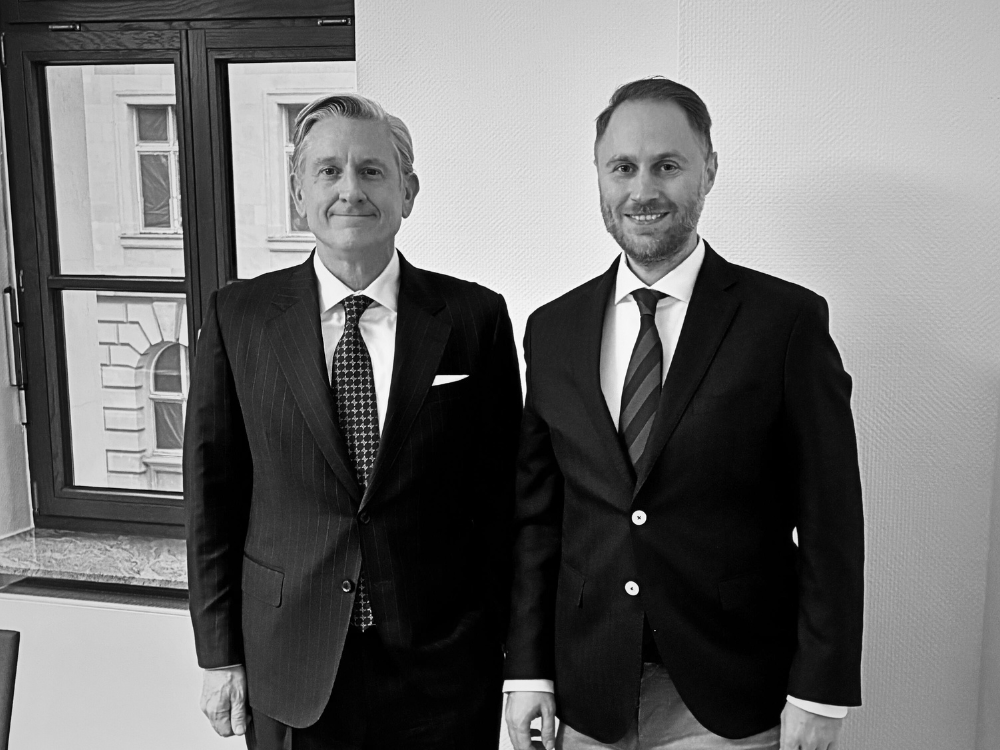
Robert Greenway und Dr. Christian Hübenthal nach dem Gespräch in Berlin
Second, China and Russia describe themselves as Iran’s partners and, at times, have made a great show of that relationship – through naval cooperation, military exercises, technology transfers, trade coordination, and various forms of strategic signalling. But when Iran came under real pressure, neither Russia nor China came to its aid in any meaningful way. That tells you something very important. It tells you that their equipment is not decisive, and it tells you that they do not come to the support and assistance of their partners when it matters most. Who does? The United States. Who acts, when necessary, to protect its interests without hesitation? The United States. And who can stop the United States from acting in this case? Nobody.
Let’s go one step further, as many people in Germany wonder: What is the long-term strategic vision behind President Trump’s foreign policy?
A healthier U.S. economy and a stronger national defence. That is the framework that guides everything. Beneath the rhetoric there is, in fact, a consistent logic. Everything comes back to economic strength and national defence. Take Greenland. The issue there is not theatrical politics. Greenland matters because it is vulnerable to Chinese economic penetration and potentially to military consequences that follow from that kind of penetration. The Chinese often enter commercially before they become strategically relevant. It also matters because Russian submarine movements and broader military activity in the Arctic have increased, and U.S. warning and detection architecture depends in important ways on a presence in Greenland.
Most importantly, if the United States is serious about building a missile defence architecture on the scale that has been discussed – what President Trump has framed as a “Golden Dome” concept – then Greenland becomes strategically indispensable. Intercontinental ballistic missiles launched from Russia toward the United States would transit airspace and detection corridors connected to Greenland. So, for early warning, tracking, and interception, the territory has enormous relevance. The mineral question is not insignificant either. But even setting that aside, the broader point is that the United States wants key strategic spaces and resources in the hands of itself and its partners and allies – not in the hands of China.
Unfortunately, this was not the major question of the discussion between Europe and the United States, at least from our perspective.
Now, one can debate Trump’s methods and language. I do not defend every phrase he uses. But I would argue that the goals themselves are not fundamentally different from what Denmark or Greenland should want either: security, prosperity, and protection against hostile exploitation. So yes, Europeans may dislike the way he says things. They may dislike how he pursues them. But the underlying objectives are neither random nor incoherent. They are rooted in strengthening the U.S. economy and strengthening the West’s strategic position.
Is President Trump’s approach essentially hard power first, with diplomacy following later?
I would put it a little differently: results matter more than style. The ultimate arbiter of a policy is the result it achieves. You can always debate the method. You can debate the tone, the rhetoric, the language used to describe a policy or to force an issue onto the agenda. But I would argue that language is less important than outcomes.
Europe liked what Barack Obama said, and it liked what Joe Biden said. But I do not think Europe should have liked very much of what either administration actually did. President Trump, for all the criticism he receives in Europe, has accomplished something very concrete: he has pushed Europe toward significantly higher defence spending. The war in Ukraine did not achieve that. Putin’s aggression did not achieve that. But Trump, by force of pressure and political disruption, did. The United States itself is also increasing defence spending on a scale not seen for decades. So, when I hear Europeans criticise the tone, I understand it. I might even use different language myself. But I do not know that I would get the same results.
How does the person Donald Trump think?
Having worked with President Trump, I learned that he sees opportunities where many of the rest of us see only problems. People like me, who come out of the national security world, are trained to think in terms of threats, crises, and risk mitigation. Trump and some of those around him often think first in terms of leverage, opportunity, return on investment, and the possibility of changing the structure of a problem rather than simply managing its symptoms. That is why I would not reduce this to hard power first and soft power later. I would reduce it to one principle: what matters is whether the policy produces the strategic result.
Talking about getting things done: Why does Cuba matter again in American strategy?
Our hemisphere is critical to us. We cannot protect our economic base or secure our citizens if we do not first ensure safety and stability close to home. Roughly thirty percent of our trade is within the hemisphere. So, when you look at mass migration, narco-trafficking, fentanyl flows, and state-enabled criminality, these are not peripheral issues for the United States. For several years, opioids and fentanyl killed more Americans annually than all U.S. wars combined since the Second World War. That is an unacceptable level of internal damage. Venezuela became the principal narco-trafficking state facilitating much of that chaos while simultaneously hosting Iranian, Russian, and Chinese influence. That made Venezuela strategically intolerable.
Cuba is linked to that picture. It has become dependent on Venezuelan energy because Russia is no longer in a position to sustain it as before. Cuba has posed a threat to the United States since the Castro era, yet for decades Washington tolerated a hostile regime ninety miles off the coast of Florida. It continues to host a substantial Russian and Chinese presence, and there is every reason to believe it could eventually host more offensive capabilities as well. There is no reason for the United States to tolerate that indefinitely. We are probably closer now than we have been in a long time to a potential change in management in Cuba. That would be good for the Cuban people, good for the United States, and beneficial to regional stability more broadly. And I do not think anyone understands that issue better inside the administration than Secretary of State Marco Rubio.
So also in Cuba, the US applies economic force to achieve its goals. Do Europeans underestimate the link between economics and security?
I do not see how the two can be separated. Your economy provides the resources for your security, and your security exists in order to protect your economy. That is the nature of a state. So, when European governments talk about defence while at the same time pursuing economic and energy policies that reduce industrial capacity, then there is an obvious contradiction. You can see that contradiction very clearly right now. Europe wants more munitions, more platforms, more defence output in general. Everyone does. But supply is limited, and there is not enough production coming from Europe. At the same time, energy policy in many countries has reduced the industrial base needed to support exactly that kind of output. That affects the defence sector, but it also affects the economy more broadly.
So yes, I think there is a disconnect in Europe between national security requirements and economic policy. Political systems are promising parts of their electorates policy goals that are ideologically attractive but not practically sustainable. As long as that remains the case, Europe will continue to find that what it says it needs is not what it is actually able to produce. This is not new. President Trump made a version of this argument during his first term when he criticised Nord Stream 2. He was heavily criticised for it at the time. But in retrospect, the disconnect was obvious: Europe was deepening its dependence on Russian gas while simultaneously describing Russia as a strategic concern. That contradiction eventually became impossible to deny.
How can Germany reverse that disconnect between economic policy and security policy?
Germany must preserve and expand its industrial capacity if it wants to meet its defence needs and potentially become a more significant exporter as well. There is no way around that. The debate in Germany often treats security and economics as separate domains, but they are not. If Germany weakens its industrial base through energy policy or through the inability to sustain production, then it weakens its defence capacity at the same time. A country cannot talk itself into security. It has to produce the material basis for it. What that means in practice is that Germany has to make decisions that support output, competitiveness, and long-term manufacturing capacity. It must ensure that energy is available at a level and a price compatible with industrial production. It has to create conditions under which defence industry can scale. And it has to recognise that security needs cannot be fulfilled if the economy is moving in the opposite direction.
If you had five minutes with Friedrich Merz or Ursula von der Leyen, who would be your choice to talk to and what would you tell them?
I would have a conversation with Chancellor Merz. I would tell him that there are more opportunities right now for Germany and the United States than there are challenges. Far more. We can do much more together in economic cooperation, and especially in industrial cooperation on the defence side, than probably any two countries can do – certainly in Europe. Germany is in a unique position to take advantage of that because it has the most powerful, strongest, and largest economy in Europe. That is a massive advantage, and it can be leveraged to improve the relationship and expand cooperation. There is no reason that Germany and the United States should not be doing greater trade, greater defence cooperation, and broader security cooperation for mutual benefit. And if he approaches the relationship by looking first at the opportunities rather than starting with the problems, then he will get much better results.
After such a long career in special forces and national security, do you sometimes wish you could be back in the field – especially now, as the Trump administration is pursuing a much more active operational approach?
There is not a day that goes by that I do not miss it. No one puts on a team’s jersey without wanting to play. I remain in close contact with friends who are still serving and who now have the opportunity to carry out missions that really matter. They are given a mission, the resources to accomplish it, and the latitude to execute. And when that happens, they produce results. Things that many people thought were impossible are now happening. These are good outcomes for the United States and, frankly, good outcomes for the world.
Thank you for the conversation, Mr. Greenway. I appreciate your time and insights.
Das Interview führte für Lagebild Sicherheit Dr. Christian Hübenthal.
In der wöchentlichen Ausgabe erhalten Sie kostenlos das vollständige Lagebild der Sicherheit.