Exklusiv: Die führenden Köpfe der Sicherheit im Interview
Kalenderwoche 38 // Politische Perspektive
“It is a kind of ballet along the
border with Ukraine.”
Rumäniens Verteidigungsminister und stellvertretender Ministerpräsident Radu-Dinel Miruta warnt vor einer zunehmenden Bedrohung an der Südostflanke der NATO. Im exklusiven Gespräch mit Lagebild Sicherheit fordert er mehr NATO-Fähigkeiten an der rumänischen Grenze und eine stärkere gemeinsame Reaktion des Bündnisses. Zugleich setzt Miruță auf den Wiederaufbau eigener industrieller Kapazitäten: Rumänien müsse nicht nur Waffen beschaffen, sondern wieder selbst produzieren können. Auch bei hybrider Kriegsführung sieht er Europa gefordert und plädiert für ein gemeinsames Vorgehen gegen russische Desinformation.
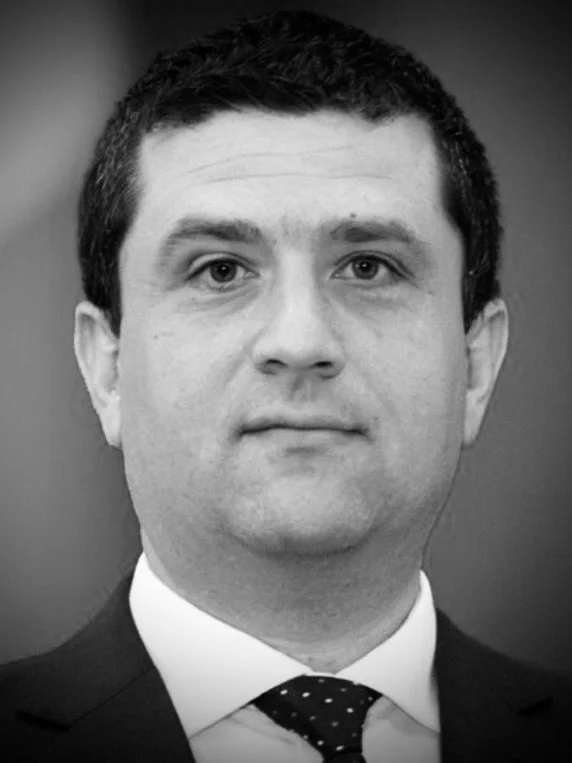
Radu-Dinel Miruta, Verteidigungsminister und stellv. Ministerpräsident Rumäniens
What is your perception of the Russian threat on NATO’s South-Eastern Flank at the moment?
The threat is increasing. Not only the threat itself, but also the frequency of incidents in the war between Russia and Ukraine is generating indirect consequences for Romania. We are observing more and more drone debris, and we are detecting violations of our airspace. We are reacting accordingly. The decision in Romania is very clear: when a drone enters Romanian airspace without authorisation or a military decision to do so, we put it down. This has happened four times so far.
We are seeing a lot of attacks very close to our border. In fact, the difference between what is happening on the Eastern Flank in the southern part, along the Romanian border, and in the northern part lies in the specific nature of the attacks. The Russians are interested in hitting the Ukrainian ports on the Danube. Because the Danube forms the border between Romania and Ukraine, they are in fact hitting targets in a territory that is just 100 metres away from our border.
In these cases, the situation is very different compared with attacks in the northern countries, where the intention may be to strike targets deeper inside the country, giving us enough time to react. In our case, we are observing the drones approaching our territory, but we cannot know in advance whether they will hit the Ukrainian ports or cross the river into our airspace. At the same time, we are not allowed to shoot down the drones while they are still outside Romanian airspace. It is a kind of ballet along the border with Ukraine: watching the drones, being prepared to shoot them down, but not doing anything before they enter our airspace.
Do you think that this is an intentional strategy by the Russians to test how capable NATO is of intercepting drones?
It could be. I don’t know. Most of the drones coming from Russia have Ukrainian targets as their destination, so in those cases, there is no interest in testing our reaction. But there could have been situations over the last year in which they intended to test how we react. We demonstrated that we would shoot down the drones, so they have been able to draw some conclusions from our reactions.
There are situations in which we do not take the decision to shoot down the drones if the consequence create risks on our territory. There are some cases, for example, when the drones are flying over a populated area, and shooting down the drone there could cause damage to people. So, we are analysing each case individually.
You mentioned that countries currently decide individually how to deal with Russian drones. Do you think NATO needs a common strategy?
No, I know that all the countries are trying to defend themselves with all the capabilities they have. But from my perspective, we should have a common discussion about resources. For example, a drone cannot enter the middle of Europe without passing over a country that is on the border. So, it would make more sense to focus many resources on the Eastern Flank, because we are here to stop what is going to fly towards the middle of Europe. We did our homework in less than four months at the Ministry of Defence in Romania. We demonstrated the capacity not only to make plans, but also to sign real contracts regarding air defence and counter-UAS.
We ordered everything that is needed: high technology that will defend the rest of the continent as well. But we have to wait for the delivery, which could take 12 or 24 months. During this time, there is not much more we can do in terms of speeding things up. From my perspective, it is a valid requirement within the Alliance to receive additional capabilities for a temporary period until we receive what we have ordered.
Do you think the threat on Romania’s borders is sufficiently recognised by other NATO states? There is much more focus on the northeastern than on the southeastern flank, even though the situation is no less threatening.
The threat is recognised. I would like to see more capabilities on the southern part of the Eastern Flank, precisely because of the differentiator I mentioned initially. At the same time, realistically speaking, I understand that there are not so many available capabilities. So, we are not talking about some countries that do not want to send them; we are talking about countries that are facing the same capability mismatch that we initially faced.
Another specific factor is the Black Sea, which has become a area where the war has been increasingly extended. So, for this additional reason, discussions about what is happening in the southern part of the Eastern Flank should be increased.
Turning to the US role: how do you assess the policy that Europeans must defend themselves on the Eastern Flank? Has NATO become weaker?
I wouldn’t say that these discussions could create a perception that NATO has become weaker. Being honest, all countries should contribute in a proportional way. So, it is absolutely normal to prove to our partners that we are doing our best, that we are investing and putting something on the table before asking somebody else to defend our country.
I’m not saying that this was the case before, but an honest discussion between partners, while we are demonstrating our contribution, is something I agree with. What we are doing is not only allocating an increased amount of money to defence. In parallel, we are bringing some production capabilities back to life. From my engineering perspective, we could reach a point where the discussions are no longer only about the amount of money. The discussions are about delivery times and about scalability in a short period of time, to be able to spend that huge amount of money. In Europe, in some cases, we are in that situation.
What I have done as Minister of Defence over the last half a year is also to increase the budget. But for the first time in the last 30 years in Romania, alongside the contracts we have signed, we are bringing production capabilities back to life where production was previously carried out. And this will be done by introducing new technology so that we are in a position to produce the latest products.
When will we be in a position to counterbalance the Russian war industry? They have huge capacities, while one of our biggest challenges is getting our own factories operational quickly enough.
In defence, in the industrial sectors, we cannot say that something is enough. So, I’m not planning to say that in one year everything we have done will be enough. We should accelerate this path every week. We should be able to demonstrate that we can produce more and that we are interacting with each other. We are not looking for 23 different solutions inside Europe for only one similar problem, which is coming from the East.
So, our plans are not to signal towards Russia that we want to attack, but our aim is to demonstrate that we are increasing our capacities in order to defend. I don’t know when we’ll reach an adequate level. From my perspective, that point of being “enough” does not exist. We are doing more and more.
Do you think the increased defence spendings will become the new normal for Europe in the next decade?
For the next period of time, it should be normal, because we cannot discuss anything else without security. We cannot discuss economic development, health or road construction without having a security layer. So, it’s difficult to explain to the population.
People cannot touch security, they cannot see it. But without investing in defence, we won’t reach the ability to deter others. So, yes, we should invest in Europe, but that investment in Europe is not to replace the United States. It’s just to improve our capacity to act in a complementary interaction with the United States. So, we do not want to replace them; we just want to add something more.
You mentioned a fair share of defence spending. Is the current cost-sharing fair, given that Eastern European countries are also defending the airspace of Germany, France, Spain and others? Or should there be a mechanism to provide more funding to the Eastern Flank?
All of the countries could introduce some specific requirements in order to prove that they need more. At the same time, we should realise that we do not have an unlimited amount of money to spend. What I consider is that, for a period of time, we should have a kind of ranking in terms of priorities, when it comes to delivery.
What is happening right now on the Eastern Flank is more intense compared to the other side of the continent. For a period, NATO and the European Union should concentrate their decisions in order to help, with what is happening on the Eastern Flank. What I mean by ‘for a period’ is until the equipment we have already ordered is delivered. We cannot ask for endless help without doing our part. Instead, we are saying: look, we know what we are missing. We did our homework at home by signing concrete contracts – not just to receive products, but to build our own production capacity.
Turning to Moldova and Transnistria, how likely do you think it is that Russia will use this issue more aggressively in the future or turn it into a full-scale conflict?
I don’t know what cards the Russians are intending to play. But what I know for sure is that we should do our best to demonstrate to the Russians that, if they are intending something, the cost will be huge. And that can happen only by investing in defence and by supporting other countries like Moldova or Ukraine. We are doing this with all our efforts.
What do you think is the best defence investment right now? Should we focus more on autonomous systems, or do we still need traditional systems and heavy equipment as well?
I’m not just thinking; I’m absolutely sure that it should be a mixed approach between them. We clearly learned lessons from Ukraine. The fight has changed, since drones were introduced into the battlefield. But at the same time, it’s very clear that drones cannot replace the heavy technology that we were used to investing in. From case to case, from situation to situation, from country to country, from terrain to terrain there is a requirement to defend with this mix of capabilities.
Turning to hybrid warfare, how exposed is Romania at the moment, and what are you seeing on the ground?
There is a huge disinformation campaign generated by the Russians. They found their way to do this in Romania because we are also fighting with a financial deficit. And as a government, we were initially in a position to increase taxes a little bit as a fourth step. And once we increased the taxes, the propaganda exploded, saying that we were asking for money from the population to send to Ukraine. We should fight against disinformation. And in my opinion, that fight is not limited only to the border countries.
It should be a common fight at the European level. As a member of Parliament as well, I introduced a proposal in the Romanian Parliament saying that social platforms should modify their algorithms in order to watermark content that has been recognised as fake. But that condition should not be asked only by one country.
We need a common European approach, because the internet has no borders and we cannot fight disinformation alone. We must protect freedom of speech, but we cannot let it be weaponised against us. True free speech belongs to people, not to thousands of AI-driven fake accounts spreading disinformation to manipulate public opinion.
Turning to AI, do you see a role for it in countering Russian information warfare while preserving freedom of speech and constitutional rights?
I’m a software engineer. For me, technically, it’s very clear that artificial intelligence can identify with 100 percent certainty and without any error what is wrong. Right now, inside the algorithms of social network platforms, fake information could technically be tagged. The problem is that after the algorithms identify the fake information, there is no reaction. There is no policy saying that this should be automatically removed or tagged as potentially fake. If somebody says that Romania has just joined a war, it’s something that can be verified automatically between institutions without human interaction.
In those cases, after such information has been verified as AI content, it could be automatically removed. I didn’t even request in my proposal that the content will be removed, but rather that a watermark will be added to that content, saying that this content is potentially fake news. That will stimulate critical thinking and limit the propagation of that fake information. But right now, this is not done.
As a final question: if you had one sentence for Europe’s defence ministers, what needs to be done now in the interest of Romania and the Eastern Flank?
We should stay united. We should understand and we should respect the arguments we introduced in the NATO discussions, saying that Romania needs help until we received what we have ordered.
Mr. Miruta, thank you very much for sharing your thoughts with us.
Das Interview führten für Lagebild Sicherheit Dr. Christian Hübenthal und Alexander Gerhardt
In der wöchentlichen Ausgabe erhalten Sie kostenlos das vollständige Lagebild der Sicherheit.
Melden Sie sich jetzt an.
-
Interview-Archiv von Lagebild Sicherheit
- 12. Sept. 2026 Christian Hadjiminas: “For the defence industry, volume is essential.”
- 12. Sept. 2026 Robert Greenway: “I think there is a disconnect in Europe between national security requirements and economic policy.”
- 12. Sept. 2026 Hans-Werner Sinn: „Wir sollten uns als bedrohte Länder Europas zusammenfinden und eine gemeinsame Armee schaffen.”
- 12. Sept. 2026 Thorsten Lambertus: „Die Herausforderung ist nicht die Innovation an sich, sondern ihr Übergang in den operativen Raum.”
- 12. Sept. 2026 Tobias Ehlke & Oliver P. Kuhrt: Zeitenwende – Werbebegriff oder eine reale Veränderung in der deutschen Sicherheitskultur?
- 12. Sept. 2026 Andreas Könen: „Wir brauchen ein Digitalbudget für die gesamte Digitalisierung des Bundes.“
- 12. Sept. 2026 Brandon Tseng: “I don’t think there was such a transformative technology since there was the development of nuclear bombs.“
- 12. Sept. 2026 Alfons Mais: „Die Einsätze haben uns vieles gelehrt, was den Umgang mit Versehrten anbelangt.“
- 12. Sept. 2026 Sönke Neitzel: „Die entscheidende Frage lautet: Ist Boris Pistorius ein mutiger Mann?”
- 12. Sept. 2026 Andreas Henne: „Zivil-Militärische Zusammenarbeit ist keine Einbahnstraße mehr.”
- 12. Sept. 2026 Andreas Marlow: „Die Lücken für die Truppe sind deutlich größer als die rein numerischen Materialabgaben an die Ukraine.”
- 12. Sept. 2026 Jens B. Koch: „Wir sind eine wertebasierte Gesellschaft, das gilt es zu verteidigen.”
- 12. Sept. 2026 Andreas Meyer-Falcke: „Wir benötigen eine zentrale Koordinierung der Informationssicherheit im Land.”
- 12. Sept. 2026 Sven Weizenegger: „Ja, wir haben Innovation verlernt”
- 12. Sept. 2026 Alfons Mais: „Ich habe es als meine Pflicht angesehen, die Dinge noch einmal auf den Punkt zu bringen!”
- 12. Sept. 2026 Sönke Neitzel: „Ich glaube, dass der Konflikt mit Russland noch lange andauern wird.”
- 12. Sept. 2026 James Hasik: „Die 100 Milliarden Euro sind ein politischer Slogan, die Institutionen müssen sich verändern.”
- 12. Sept. 2026 Marie-Agnes Strack-Zimmermann: „Wir registrieren, dass Deutschlands Tun und Handeln in Moskau besonders beobachtet wird.”
- 12. Sept. 2026 Konstantin von Notz: „Generalrevision und Überwachungsgesamtrechnung sind überfällig.”